Wednesday, 13 August 2014

Big Year, Big Goals, Big Fears...


So it's been a good 5 or 6 months since I have last had the chance to write. Scratch that, its been about 5 or 6 months since I have had the confidence and desire to write about homeschooling my children as I have been too wrapped up in my own fears and doubts. We have been plugging along, slow and steady, but as each month goes by my little cloud of doubt gets bigger and bigger.

What if I am unable to recognize my own deficiencies as a teacher and pass those straight on to the most important students I have ever had?

My children are young, at an age that I would argue is "crucial". Not that every age isn't "crucial" in terms of learning development, but I have always argued that it is the early years, the ones where skills are being learned, that frame the learning path. I feel as though learning throughout life is similar to building a house-you need a strong foundation to start with in order for all the other pieces to gel together and remain strong and solid. Furthermore, the higher the structure, the more that the foundation needs to support, the more important its structure and development becomes.


My background in teaching is one surrounded around math, science, engineering and technology. I have taught both high school and middle school level. I have tutored many students from all sections of the "learning spectrum" and yet I am still nervous. Scared of the unknown, petrified of the responsibility. I understand why people pay me to tutor their children in math and science, or at least I have a theory. I feel as if it is the same reason that my little doubt cloud is getting bigger. I have associated my difficulty in school with languages and arts with an inability to learn and teach it. And that if I do not "know" it I will not be able to teach it well enough and my children will suffer. And I will be the SOLE PERSON responsible for that. And that because it is just me, I will not even be able to recognize that I am doing it poorly until their house gets to be 2 or 3 stories high and the whole thing comes crumbling down. I know this may sound disgusting, but in a way there is some comfort in the idea of someone else being responsible for my children's learning, and in having someone else to blame when or if they don't.

I suck at spelling. My writing of this blog has even been criticized. My language teacher in high school, as he put it, "gave me an 80 because he liked me." In this day and age, where everyone is emphasizing the importance of communication and collaboration, I wonder how my weaknesses influence my children, especially if they are not exposed to individuals with strengths in those areas. It doesn't matter if you are the best scientist in the world, it doesn't mean squat if you can't communicate your knowledge.

But maybe, just maybe, having these fears is enough. Maybe recognizing that no teacher, public or private, schooled or unschooled,  needs to be an expert in everything or anything in order for a child to have a good foundation. Maybe the importance of who I am teaching will be the new driving force to find my love of languages.

...or maybe I will just get a language tutor.


Friday, 28 February 2014

"Mommy, Somebody Took Uranus away"

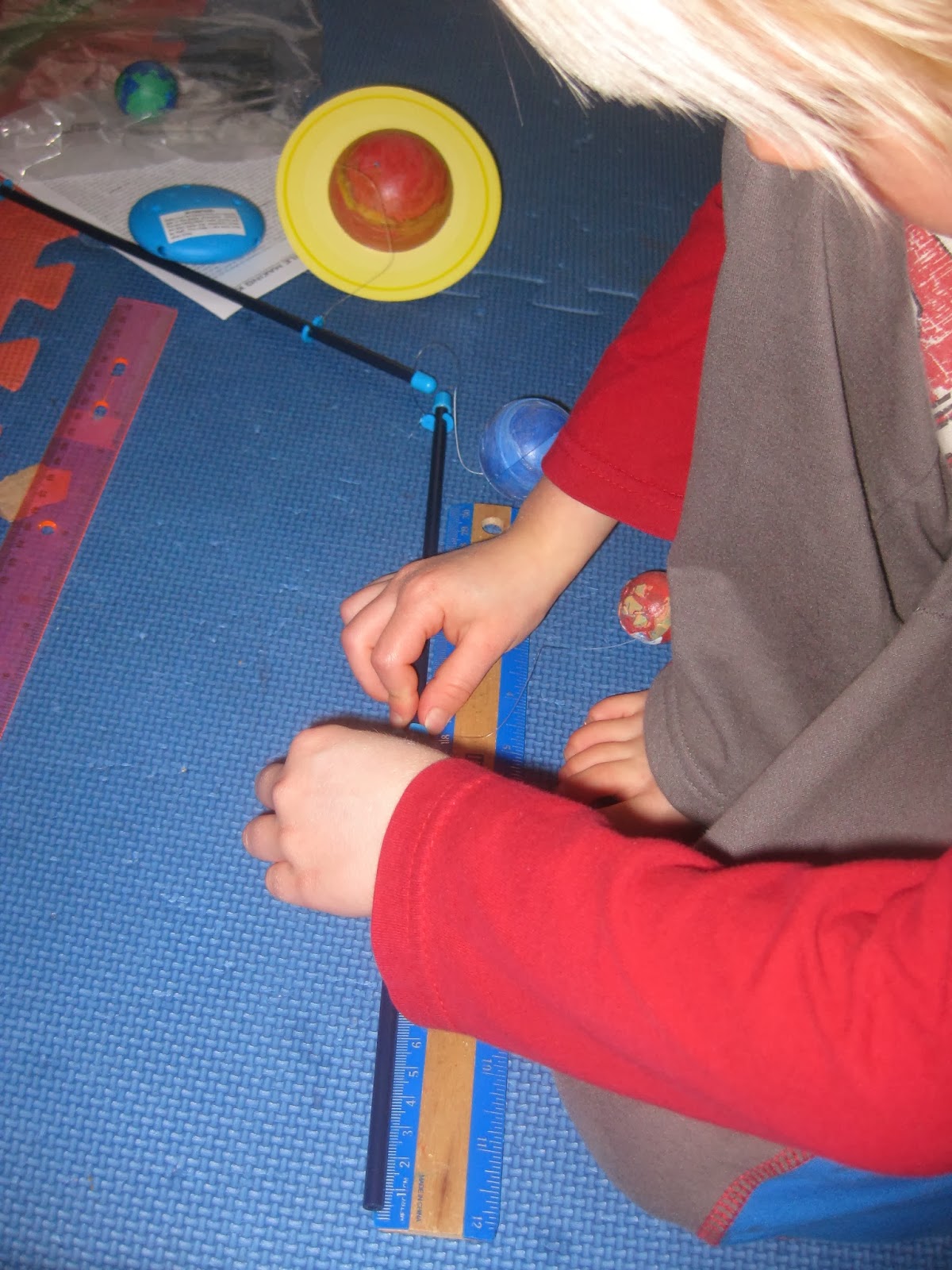
...is a sentence I will remember until the end of time thanks to a 3D Glow-in-the-Dark Solar System mobile kit by 4M. My son, and my daughter by proxy, have become remarkably obsessed with learning everything about space. You may remember a previous blog post in which I came home to a solar system on the wall, forcing me to think about how I could take this interest and extend their learning even further. Two weeks and twenty bucks later, I had a mini project in my hands-one that provided an extension of their interest in space with a little bit of art and some measurement and dimension analysis.

Although I am acutely aware that this "topic" is not officially located in the Ontario curriculum documents until grade 6, I truly could care less, as I have always felt that any "topic" can be taught at any age, provided it is at the right learning level. Also, I think it would have been pretty stupid silly to let this one fizzle out and die simply because they aren't "suppose" to learn it until they are 11 years old.

The reason that I chose this model in particular is because it not only provides a three dimensional representation of our solar system, but it also requires the user to paint and assemble each planet and then measure out both the length of string as well as the distance between each planet, in order to have a somewhat realistic representation of our solar system.

When painting the planets that came complete with topological features, my children decided to use their "Big Book of Space" along with the cover of the box as guides-reinforcing their "research skills" along with their artistic ones. Naturally the kit only came with a strip of primary colours plus black and white, so I used that "opportunity" to discuss primary colours and colour mixing and a little bit about light and dark as they made the rest of the colours they needed according to their references.

Once the paint was dry, they applied the glow paint as I threw in a little bit of information about what a phosphor is and how it sucks up light and then spits it out. We then moved on to the actual setting up of the mobile, and now I know why baby mobiles cost 50 bucks, even at Walmart!

Rather than do it myself, I asked my children to read the instructions and help me make sense of the diagram. They each measured out the string length for 4 planets and then worked together to space them out properly along the mobile rods.


They ended up with a beautiful model of the solar system that will continue to give them a visual representation of the planets, the sun and the concept of an orbit. I ended up with a project that incorporated science, math and art, all for the cost of 20 bucks and 5 days of time.


The downside? They are fighting over who gets to have it in their room at night, so another purchase and project may be coming down the pipeline!

Saturday, 21 December 2013

How Baking and Christmas Cards Can Cover A lot of Math, Science, English and Art

I love everything about Christmas. As soon as November 1st hits and the mall turns into a wonderful display of commercialism, I start thinking about cookies and Christmas cards. This year is the first year my kids can read and write and so I figured it would be great idea to create a Christmas "project" that would not only hit all the right "schooling" buttons, but leave me with enough cookies to last until New Year's!

I decided to let my children create all the Christmas cookie and card gifts this year-one for every neighbor, friend and dog we know.


They each came up with a unique card for every person on our list, not only showcasing their magnificent art "skills" but also allowing them to practice their printing, spelling and writing skills. I only had one request-that they try and come up with one unique personal message for each card.


They then used the computer to look up all the addresses we needed, addressed each envelope, slapped on a stamp and put them in a pile by the front door.

Then came the super fun part-making lots and lots and lots of yummy Christmas cookies. For those of you who bake, I am sure that the following sentence is of no surprise to you:


Baking can have a heck of a lot of math and science in it. 


When we made our cookies we started with measurement-cups to mL, teaspoons to grams and the idea behind doubling and tripling recipes as the additional of another group (or two groups respectively) of whatever we needed.


We then revisited solids and liquids and I introduced the idea classifying substances by their various properties-wet and dry, sticky and greasy, hard and soft, crystalline and amorphous. We also talked about following a method to ensure consistent, fluffy cookies and discussed the reasoning behind a method or a recipe.


We used cookie sheets and cookies to show groups of 4 and 5 as well as played a little with visual multiplication and division. I used various amounts of cookies on a sheet, let's say 12 for example, and then had them determine things such as what half the cookie sheet would be, two cookie sheets and so forth. We made up questions like "if the littlest one ate 4 cookies, how many would be left"  and just generally had fun playing with cookies. 


Then we ate a whole heck of a lot of them and spent the evening lying down in a cookie induced coma. 

Good food, good fun, a good day even including the time the kids were bouncing off the walls in a mom-induced sugar high :)

I love Christmas!

Tuesday, 26 November 2013

The Moment I Knew He Wouldn't Be Going To Public School...

Last week I went to teach a math, science and technology (MST) class at a middle school (I teach from time to time) in my city and left my children with their father. I spent my entire day trying to get 13 year olds to research a topic and analyze and interpret the results. A tiring task to say the very least as they had a lot of difficulty with critically examining a piece of information and creating a way to share their thoughts and interpretations with others. When I got home, frustrated and defeated, I saw this on the wall going upstairs:


I asked my son and daughter what it was I was looking at, my son looked at me as though I was born last week and said "its the solar system-can't you see that?"

I replied with the obvious "is that what you guys did with daddy today?"

To which my son replied "no daddy was working so I read my Big Book of Space and then made my own solar system and taped it to the wall...do you like it?"

Of course I ignored the fact that it guaranteed a fresh coat of paint would be needed next spring and replied "I love it, did you do it all by yourself?" because in all honesty, I was completely shocked at what I saw in terms of the amount of detail that went into it-the relative size of the planets, the colours, the moons and the correct placement-and felt as though he must have had help...

He then said that his little sister had helped him with it a little bit-which delighted me even more because it meant that not only did they manage to do what I was desperately trying to get my grade 8's to feel comfortable doing-but also that they (somewhat) collaborated on the final product, a great bonus!

I wonder if the reason I had so much difficulty trying to illicit the same response from a middle school classroom was because they are not privy to the same opportunities that my children have been. At the beginning of the year, I went out and bought a boatload of books-all levels, a variety of topics, a variety of genres-and then just dumped them in the center of the living room and waited. Slowly but surely my little sponges pick up book after book and taught themselves-about nature, dinosaurs, provinces, rocks and minerals, seasons, mannerisms...and apparently planets as well. The opportunity they have to pick and choose at their leisure (mostly) what to read, what to learn, and what to do with what they have learned has allowed them to flourish in ways that I couldn't have dreamed up even using every "great lesson plan" that's floating around on the internet!


All children are born with an innate curiosity and desire to learn about the world in which they live in-I'd argue that it's part of what makes us such a dominant surviving species. I guess what I learned that day is that if you create the right environment, one in which learning is fun and not forced, resources are varied and plentiful, and give them the time they need, then there exists the possibility of true education.

I also knew that day that I could not risk taking this amazing gift away from my children by putting them in public school. I knew in my heart that this side of them would get lost in the midst of forced assignments, tests, and curriculum guidelines. And that left in that situation they too would end up in grade 8 without having the ability and desire to be able to first determine what it is they want to learn, then learn about it, then communicate their knowledge with others in a creative way.

That was the day I decided to truely sign myself over, heart and soul, to the education of my children. I'm all in baby.


Thursday, 31 October 2013

Dairy Day-Why it Never Ever Hurts to Ask!

I know one of the concerns that I hear all the time under "the problem with homeschooling" is that kids will miss out on field trips and get-together's with other kids, so I decided to share a wonderful experience in the hopes that some of those misconceptions may be laid to rest!

When I went to my city fall fair this year, I met a woman (lets call her Beryl) from the Dairy Education Program. This program is run through the dairy farmers of Ontario and according to their website is a "free service to teachers and provides interactive, curriculum-connected in-class workshops for elementary schools in Ontario". My kids were naturally enthralled by the presence of a mechanical milking cow and decide on their own to become her newest students by firing questions at her in rapid pace, barely waiting for an answer before firing again. I took this opportunity to ask her if she had ever done a homeschooling workshop (she hadn't) and if she would be interested in doing one. 10 emails and one month later she was at my door, complete with blow-up cow, a mechanical milker, videos, props and displays ready to teach our city homeschooling group all about the wonders of dairy!


We choose to focus on the basic path of milk from cow to store and on the concepts of solids and liquids. She started with the habitat and diet of cows, which came complete with actually straw, hay, corn and seeds that we passed around in our little learning circle. This was followed by videos of dairy farmers that were parodies of current pop songs, including one that remained stuck in my head for about a week called "Farm it Maybe" that my daughter absolutely loved.


We then moved on to states of matter-otherwise known as solids, liquids and gases-which was wonderfully illustrated with the use of actual dairy product examples complete on a Velcro board and appealed to our wide range of ages and learning levels.


The piece de resistance though was our final activity-making butter with cream! We discussed the state of cream (liquid) and its contents (fat and water) and then through physical separation techniques-i.e. shaking the crap out of the container-we turned our fat and water liquid into solid butter in a mostly water liquid! We then separated the butter out and put in on crackers and ate it all up! It was deliciously fresh and remarkably fun and easy to do!

I guess the point of this blog post is to illustrate the concept "it never hurts to ask". There are many resources available within a city that are just waiting for someone to come along and ask. A fellow homeschooler I know organized a fire station visit, another one a Halloween party, myself a dairy day. I guess what I am trying to say is that homeschooling allows the opportunity for a wonderful educational experience-but just like anything in life, one must seize the opportunity! I encourage you to explore your city and its surroundings and ask, ask, ask! Most people love to share their knowledge, especially
with the ever-rare child who wants to learn! And if anyone has any similar experiences they would like to share, please do as I would love to seize another opportunity!


Friday, 11 October 2013

Fun With Fall Using an STEM Framework (Science, Math, Technology, Art)-STEP 1!

We started our "Fun with Fall 2013" project today with...drum roll please...step 1!

To integrate Nature of Science concepts when we out to collect our leaves, we discussed which trees the leaves fell from as well as why they fall in the fall and then took pictures of them for later research . Science Made Simple gives a great straightforward explanation for kids as to why leaves change colour and fall that I plan on using later when I ask them to do their own research-and bonus, it also has easy fall experiments!

When we got home we knew we had to bag them so they would keep, so I integrated a little bit of math by having them sort the leaves. That's all I said, just "sort the leaves" in order to let them sort in whichever way they wished. Given their ages, I expected them to sort by colour-and colour is what they did:


That's as far as we got the first day of "Fun with Fall 2013", but we could have gone one step higher and sorted by shape or size within colour as well.

The entire outline of "Fun with Fall" can be found here. Our next step will be to spend some time counting them-things like the total amount and how many colours of each and I will use that to very briefly introduce the mathematical representation of a fraction with a brief discussion with the not-so-littlest one as to what parts of a total are. The littlest one and I will discuss more and less with connections to physical and numerical representations of each. I may get her to also do some adding and introduce some "word problems" along the lines of "how many leaves are not red"? etc.

To be honest, I haven't figured out just how far I will take this yet, I plan on basing it on how they respond to each idea on a day-by-day basis. But I guess that's part of the advantages to homeschooling; that I have the option of being able to take it day by day and cater it to what and how my children learn. And yes I know, all teachers everywhere do with their students, but I don't have the same constraints they do-I am free to alter as I see fit, and my children are free to learn as they see fit!

Stay tuned for part 2-T.B.D.

Fun With Fall-Incorporating Science, Math, Technology, and Art-A Full Project Outline!

One of my favorite things about Ontario is fall-the crisp morning air, the delicious smells and the beautiful colours. I find it remarkably difficult to spend time inside once the leaves start to turn, so I tried to come up with a project that would maximize the time I could be outside. I was thinking of the kids as well, but in all selfish honesty, I was mostly thinking about me! 
I entitled my project "Fun with Fall 2013" and here's how it breaks down. 

Step 1-Collection

The first step is to, you guessed it, go outside! On a beautiful fall day spend 2-3 hours collecting leaves. Find as many different leaves as you can-different colours, different shapes, different sizes and different patterns (in the middle of changing from green to yellow versus from yellow to red for example)-and get a few of each to use for different purposes. If you put leaves flat into Ziploc freezer bags, they will stay moist enough to use for weeks! Take pictures of the trees that the leaves came from to use later on in your students research. 

Step 2-Curriculum Integration
I figured the best way to illustrate how you can use leaves and autumn in general in your teaching would be to break it up by "subject" and then leave it (hahaha, get it?) to you, the readers, to decide on which aspects would work for your students. For those of you who want to know where each particular concept fits in the Ontario curriculum  I have also included the subject, grade level(s) and specific strands so you can adapt them to your liking. So here goes:

Math:
Sorting by colour, shape and size (Grade 1:Geometry and Spatial Sense)
Counting both the total amount and amount of each group (Grade 1 Number Sense and Numeration)
Patterning (Grade 1, Patterning and Algebra)
Graphing of each leaf group made earlier when sorting-either pictorially or numerically (Grade 1 Data Management and Probability)
Percentage and fractions (Grade 2/3/4 Number Sense and Numeration)

Science:
Classification of the leaves and their corresponding trees (Grade 1/2/3/higher, Needs and Characteristics of Living Things)
Plant food production and how it relates to the colours of fall (Grade 1-8 Life Systems)
The influence of climate on plant species (Grade 2-8 Life Systems)

Research and Technology:
Using the internet as a tool to research the names/families of the trees/leaves and where else in the world they are found and why
Creating a graph with MS Excel after pictograph/handmade graph is done.
Use Ms Excel or similar software to create a pie circle to introduce/reinforce the concepts of percentage and fractions.

Art (Grades 1-8, Visual Arts):
Rubbings and tracings
Create a painting incorporating leaves
Creating leaf stampers to make a colour collage
Creating a collage in the shape of a leaf, using leaves

I think that this could by a great cross curricular project that would incorperate enough topics to make it a truly valuable "fun with fall" experience! I plan on trying everything and will write about it-the good, the bad and the ugly-as we try it!

If any of you give any of this a go, or have something similar, please comment/share with me, I would love to here about how you had "fun with fall"!